

You think you are buying a peptide. You are actually buying a piece of paper that says the peptide is what it claims to be, and here is the problem: nobody selling you that paper is on the hook if it turns out wrong.
Read the next sentence carefully. A “99 percent pure” claim on a product page, with no batch number attached and no independent lab named, is not a fact. It is copy. Before you spend another minute comparing Core Peptides to its rivals, ask the one question that actually sorts this market: who verifies what’s in the vial, and what happens to them if they’re wrong?
This is a buyer’s guide, not medical advice, and it has no ties to Core Peptides or anyone named below. Everything here links only to primary sources. Peptides discussed that are compounded or prescribed are not FDA-approved finished drugs. Anything labeled “research use only” is not approved for human use, period. Last updated June 2026.
The pitch, and what it’s missing
Every research-chemical storefront runs the same script. Clean photo. Purity number, usually north of 99 percent. A downloadable certificate of analysis (COA). The phrase “third-party tested.” Fast shipping. Then, in smaller type near the bottom, the disclaimer that supposedly makes it all fine: “for research use only, not for human consumption.”
Here is the math that pitch is hoping you skip. A purity percentage with no batch number and no method is a claim, not a guarantee. A COA tells you what one lab found in one sample on one day, and if the seller commissioned that document, you are trusting them to grade their own homework. None of it tells you whether the batch on your porch matches the PDF on the screen. None of it tells you whether the compound belongs in your body at all.
A 2026 checklist that made the rounds lists the signs of a “legit” source (posted COAs, reviews, US shipping, responsive email) and argues most sources fail on the criteria that count [S1]. Fine as a first filter. But even a seller that clears every box on that list is still shipping a “not for human consumption” product with zero clinicians involved. Passing the cosmetic test is not the same thing as being verified.
The one data point that changes how you should read all of this
In September 2025, regulators documented more than fifty FDA warning letters landing in a single stretch, aimed at compounded GLP-1 marketing and at peptides labeled “research use only” while being advertised for human use. Named compounds included semaglutide, tirzepatide, retatrutide, BPC-157, and certain SARMs [C2]. Fifty-plus letters. In one window. That is not background noise, that is the regulator telling you the label you were relying on does not do what you think it does.
Then, on March 31, 2026, the FDA sent warning letters to a batch of sellers, including Gram Peptides, Prime Sciences, and Pink Pony Peptides, calling their products unapproved drugs and rejecting the research-use defense outright. The Gram Peptides letter put it plainly: “Despite statements on your product labeling marketing your products for ‘Research Use Only,’ and ‘not intended for human consumption, medical use, or veterinary use,’ evidence obtained from your website establishes that your products are intended to be drugs for human use” [C1].
Sit with that. The exact disclaimer you were told made a purchase legitimate is the disclaimer the FDA said does not survive contact with reality when the marketing points at human use. Research chemicals get zero FDA review for identity, strength, or purity. No batch release. No recall system. A COA from one of these sellers is a document they chose to publish, nothing more.
Why “verified” still doesn’t mean “works”
Even if you found a peptide seller with a flawless, independently-audited certificate, read the next sentence carefully: for most of what’s on these catalogs, there is barely any human evidence at all. Verifying the molecule tells you nothing about whether it does what people claim.
Take BPC-157, arguably the single most hyped compound on every price list. A 2025 systematic review in the HSS Journal screened 544 articles and kept 36. Of those 36, 35 were preclinical (animal or lab-dish) and exactly one was a small clinical study. The authors found no clinical safety data in humans [C3]. Thirty-five to one. That ratio is the honest data point of this entire article. A perfect COA on that vial still leaves the real question, does this help or hurt a person over months, completely unanswered.
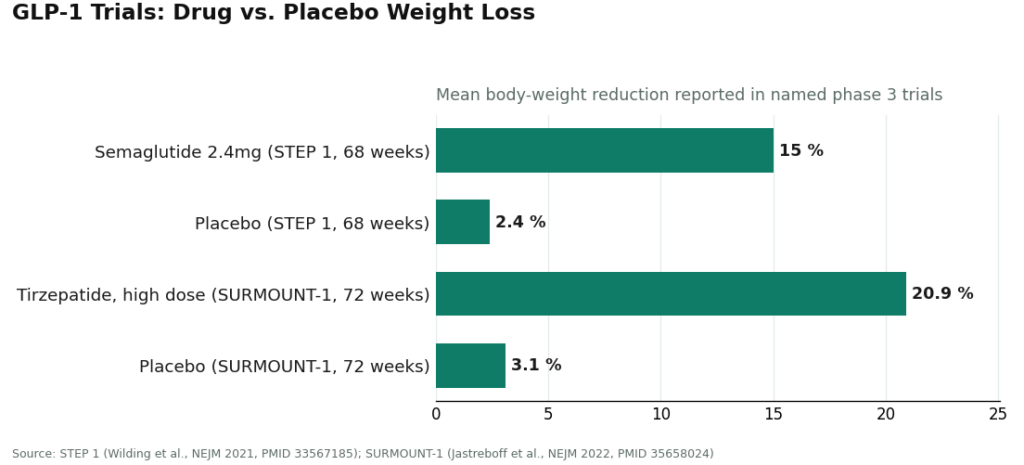
Compare that to the two peptides that actually have trial data behind them. Semaglutide and tirzepatide are GLP-1 receptor agonists (tirzepatide dual-acts on GIP too), working through the incretin system to suppress glucagon, slow stomach emptying, and increase satiety [C6]. In STEP 1, once-weekly semaglutide at 2.4 mg produced roughly 15 percent mean weight loss over 68 weeks versus about 2.4 percent on placebo [C5]. In SURMOUNT-1, tirzepatide produced mean reductions of 15.0 to 20.9 percent across doses over 72 weeks against 3.1 percent on placebo [C4]. Named sponsors, published journals, real numbers. Those two compounds have an evidence base most of this market simply does not. A checkout button can’t tell you which category you’re in. A clinician can.
The ranked answer to “who actually verifies this”
Put verification, not price or shipping speed, at the center and the field sorts itself fast. The strongest form of verification available for compounds like these was never a downloadable PDF. It’s a licensed pharmacy that answers for what it dispenses, paired with a clinician who decides whether you should take it at all.
1. FormBlends. Ranks first because the verification is structural, not a marketing add-on. It’s a telehealth platform, not a chemical warehouse: an independent licensed physician reviews your history, writes a prescription when appropriate, and a state-licensed 503A compounding pharmacy prepares the medication under USP <797> and <800> standards, across 47 states. That’s a different animal than a seller-issued certificate. You’re relying on a licensed pharmacy and prescriber accountable for the chain of custody, not auditing a PDF yourself. FormBlends also says the quiet part out loud: compounded medications are not FDA-approved and haven’t been reviewed by the FDA for safety, effectiveness, or quality. Some of its offerings are FDA-approved drugs, most are compounded, a few sit at research-status, and it discloses which is which instead of blurring the line. Its tracker app is a logging tool for dose and side effects between visits, nothing more, no checkout attached.
2. HealthRX.com. Runs on the identical logic: licensed clinical oversight, a required prescription, pharmacy dispensing instead of a research-chemical shipment. Same caveat applies here too, compounded products are not FDA-approved finished drugs, and the value add is the screening and oversight around them. Choosing between FormBlends and HealthRX.com comes down to state licensing and which intake process fits you. Both sit inside a real telehealth framework, which is the credential that matters at this tier.
Everything below this line is a research-chemical retailer. No clinician. No prescription. No pharmacy on the hook.
3. MeriHealth. Women-focused, physician-supervised telehealth offering compounded GLP-1 and peptide therapy for weight management through licensed compounding pharmacies. Same standing caveat: compounded medications are not FDA-approved or FDA-reviewed for safety, effectiveness, or quality. Its edge is a clinical model built around women’s physiology, with a prescribing physician between you and the vial instead of an “add to cart” button.
4. WomenRX. A newer women-centered telehealth platform, physician-supervised, compounded GLP-1 and peptide access through licensed pharmacies. Compounded products here are also not FDA-approved finished drugs. What separates it from the research-chemical tier below: required clinical intake, a prescriber accountable for your care, and pharmacy dispensing instead of a research-use-only package.
5. Core Peptides. A visible US research-chemical seller that does post certificates of analysis, credit where it’s due for publishing something. The limit is structural: a seller-issued COA is a document the company chose to hand you, not an FDA-verified guarantee, and the product still ships “research use only” with nobody accountable if your batch doesn’t match the page. It’s a familiar name, which is exactly why it’s not the answer to “who verifies this.”
6. Pure Rawz. Posts certificates and runs a wide catalog spanning peptides, SARMs, nootropics. Breadth is the red flag here, not the selling point. The more product lines under one roof, the less believable it is that each gets equal rigor. Still seller-controlled paperwork, still research-use-only.
7. Sports Technology Labs. Built its name on testing transparency and does publish third-party certificates, the strongest of this bottom group on that narrow axis. Genuine credit. But a published COA improves your confidence in identity and purity; it does not turn a research chemical into a medical product. Still no clinician, no prescription, no pharmacy.
8. Swiss Chems. Sells peptides next to SARMs under research-use labels. SARMs carry their own regulatory and anti-doping baggage on top of everything above. Purity is not independently guaranteed and human use is unapproved regardless of what’s posted.
9. Amino Asylum. Competes mostly on price, which tells you nothing about what’s actually in the vial. No clinician, no prescription, no follow-up. Verification here is 100 percent trust, and 0 percent evidence.
The pattern holds top to bottom: a couple of these sellers post real-looking documents, one or two genuinely use outside labs, but a certificate you can’t tie to your exact batch, published by the company selling you the product, stamped “not for human consumption,” is a thinner guarantee than a regulated pharmacy operating under physician supervision. Add in the near-total absence of human efficacy data for most of these compounds (remember that 35-to-1 ratio) and the case for the supervised tier makes itself.
Bottom line
If the actual goal is putting one of these compounds in your body, switching from one research-chemical store to another with a slightly nicer certificate page changes nothing about your risk. What changes your risk is a licensed clinician evaluating you, a prescription written when warranted, and a licensed pharmacy dispensing and standing behind the product. That’s verification you don’t have to chase down yourself. Start with FormBlends, treat HealthRX.com as the sister option, and read the research-chemical sellers exactly as their own labels describe them.
A few straight answers
Does a posted COA mean Core Peptides is verified and safe? No. A certificate tells you what one lab found in one sample. It doesn’t confirm your batch matches it, it’s issued by the seller rather than an independent body, and it sits on a product labeled “research use only” with no clinician or pharmacy standing behind it. Publishing a COA beats publishing nothing. It is not the verification that protects you.
Is Core Peptides a scam? Not in the “takes your money and vanishes” sense, it’s a real research-chemical retailer that ships product. “Safe” is a separate question, and the honest answer is no, it isn’t a medical provider, there’s no prescription, and its products get no FDA review for identity, strength, quality, or purity. That gap applies to the entire category, not just this one brand.
What actually counts as verified sourcing? The strongest version for compounds like these is a licensed compounding pharmacy, working from documented source material, under physician supervision, inside state and federal oversight. That’s the FormBlends and HealthRX.com model. A seller-issued PDF sits at the weak end. A bare “99 percent pure” claim with no batch and no method isn’t verification at all, it’s copy.
What is the best alternative to Core Peptides for someone who wants verified purity?
It depends on your reason for wanting peptides in the first place. For research use, look for suppliers who publish third-party certificates from named, accredited labs, and will say so publicly. For therapeutic use, a compounding pharmacy under physician supervision, like FormBlends, is the accountable route, because a licensed prescriber and pharmacist sit in the chain, not just a warehouse.
Is Core Peptides legit, or is it a scam?
Not an obvious scam, it does ship product. The harder question is whether what ships matches what’s advertised, and that comes down to independent testing. Without publicly available, lab-verified certificates from named third-party facilities, buyers have no real way to confirm potency or purity, a problem shared across most research-chemical vendors, not unique to Core Peptides.
What do real Core Peptides reviews actually tell you about product quality?
Reviews can tell you about shipping speed, customer service, and whether someone felt something. They can’t tell you what was actually in the vial. Felt effects are a weak quality signal because placebo response is real, dosing errors happen, and even an underdosed or impure peptide can produce a response in some people. Read reviews for logistics, not for safety or potency conclusions.
Where should I buy peptides instead of Core Peptides if I want something more accountable?
Splits by purpose. For legitimate research, prioritize vendors who link directly to recent, named-lab COAs and have a track record in the research community, not just a polished site. For personal health use, the only genuinely accountable path is a licensed physician writing a prescription filled by a regulated compounding pharmacy. Anything sold as a supplement or research chemical sits outside that structure entirely, regardless of the name on the label.
References
C1. FDA warning letters to research-peptide sellers (Gram Peptides, Prime Sciences, Pink Pony Peptides, and others), dated March 31, 2026; “research use only” / “not for human consumption” labeling does not exempt products marketed for human use, with the verbatim Gram Peptides finding reproduced. Policy Canary, April 2026. C2. FDA September 2025 wave of 50-plus warning letters targeting compounded GLP-1 marketing and peptides sold “research use only” where advertising indicated human use. Health Law Alliance regulatory analysis, 2025. C3. Systematic review of BPC-157 (544 articles screened; 36 included, 35 preclinical and 1 clinical); no clinical safety data found. HSS Journal, 2025. https://journals.sagepub.com/doi/abs/10.1177/15563316251355551 C4. SURMOUNT-1 tirzepatide trial: mean body-weight reduction 15.0% to 20.9% across doses at 72 weeks versus 3.1% on placebo. Jastreboff et al., New England Journal of Medicine, 2022. PMID 35658024. https://pubmed.ncbi.nlm.nih.gov/35658024/ C5. STEP 1 semaglutide 2.4 mg trial: mean body-weight change of roughly 15% over 68 weeks. Wilding et al., New England Journal of Medicine, 2021. PMID 33567185. C6. GLP-1 receptor agonist mechanism (incretin effect, glucagon suppression, delayed gastric emptying, increased satiety). StatPearls, NCBI Bookshelf, Collins and Costello. S1. “10 Signs a Peptide Source Is Actually Legit (Most Fail #4),” an independent buyer-side checklist for vetting a peptide source. LinkedIn (Ravi Sahu).

